
The Crown Event Center Decision
Why We Had to Say No.

**Note updated October 2025 for totals spent & recovered
Sometimes the hardest part of leadership is making decisions that disappoint people who trusted you with their hopes and dreams. The Board of Commissioners’ recent decision to halt the downtown Crown Event Center project is one of those moments, and you deserve a full explanation of how we got here and why we made this choice.
The Numbers That Changed Everything
When our board took office, we inherited a project that had fundamentally changed from what the community originally supported. The cost escalation tells the story of a project spinning out of control:
2015: Renovation estimates were $35 million
2021: New facility estimates were $75-80 million
2022: Professional estimates reached $132 million
2024: Costs reached $163 million
2025: "Reduced" to $144 million (excluding the required $33 million parking deck)
This represents more than a 100% increase from the original projections, bringing the total to $178 million for a project with a series of insurmountable flaws not supported by facts to justify the increased size or design.
Let me put that in perspective: we're talking about nearly doubling the original cost of a flawed project with a size and design that was beyond what the experts said would be successful. Why?
An “Event Center” or “Performing Arts Center”?
Before we dive into the community survey results, it's important to clarify what was actually being proposed. This was an "event center," not a "performing arts center" (think DPAC) that many residents envisioned when the project was first presented. The distinction matters enormously—a performing arts center focuses on theater, dance, music, and cultural programming. An event center (with a flat floor, I might add) is designed primarily for conventions, and larger-scale events with much more limited programming diversity. Yet many supporters, including organizations like the Cool Spring Downtown District, continue to refer to it as a performing arts center. This fundamental misrepresentation of the facility's purpose helps explain why community expectations never aligned with what was being designed and why the usage projections were so limited.
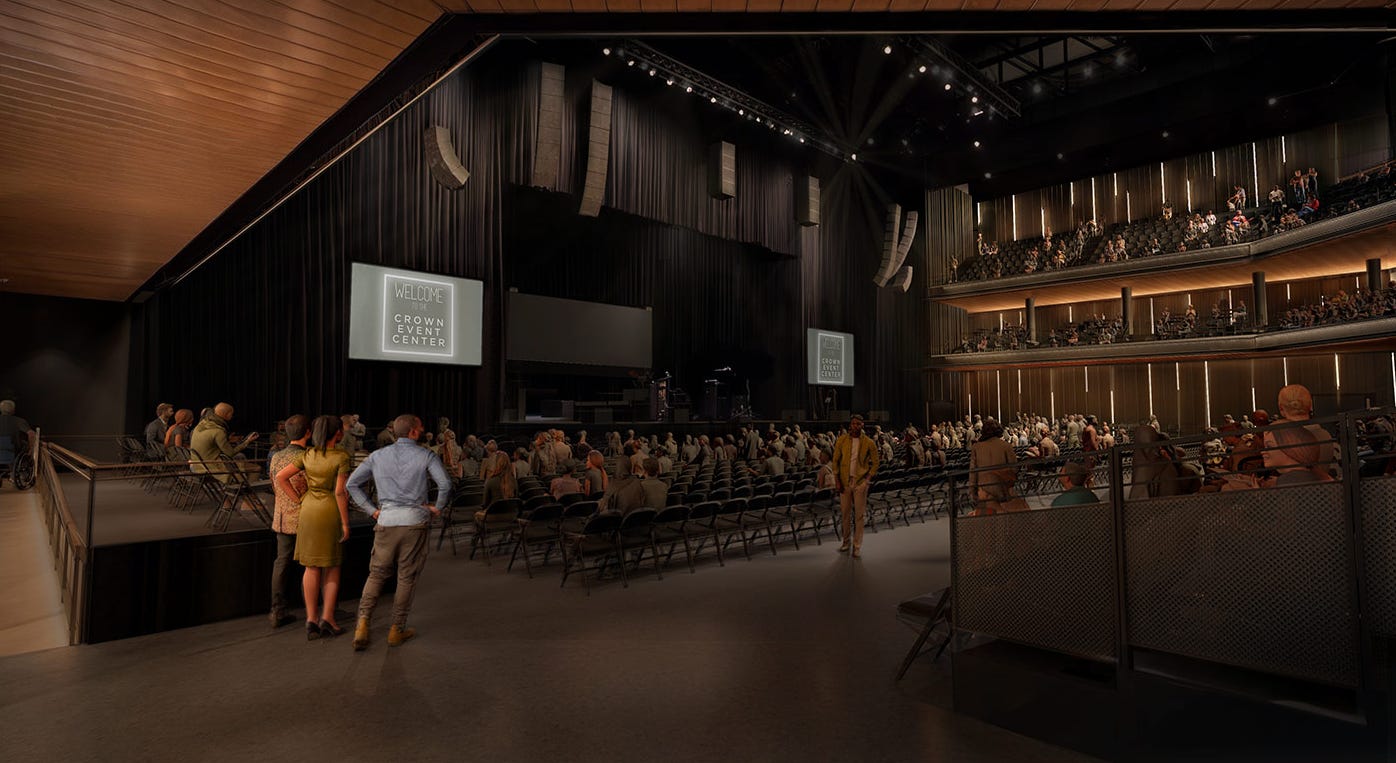
Compounding this issue, the programming and scope that drove up costs were shaped by user group workshops hosted by the architect that included only 28 people from the community across 11 meetings. Twenty-eight people along with the project team essentially designed a multi-million facility. Even more troubling, the meeting notes from these workshops show that participants expressed caution about the size, layout, and production scope—warnings that were apparently ignored as the project continued to expand. This limited input process helped drive the project far beyond what the broader community wanted, what the participants themselves recommended, and what experts said would be successful.
What the Community Survey Actually Said
Here's something that might surprise you: the community survey of 1,110 residents that was used to justify the downtown location actually showed majority support for renovating the existing Crown Complex location, not building downtown.
Before evaluation criteria were weighted to favor the downtown site, residents preferred investing in our current Crown Complex. The data was there, but the interpretation was shaped to support a predetermined outcome. Here is what the consultants presented to the board- (https://bit.ly/ECFS2021 - slide 13). If you want to read the full study it is here - https://bit.ly/cecstudyfull
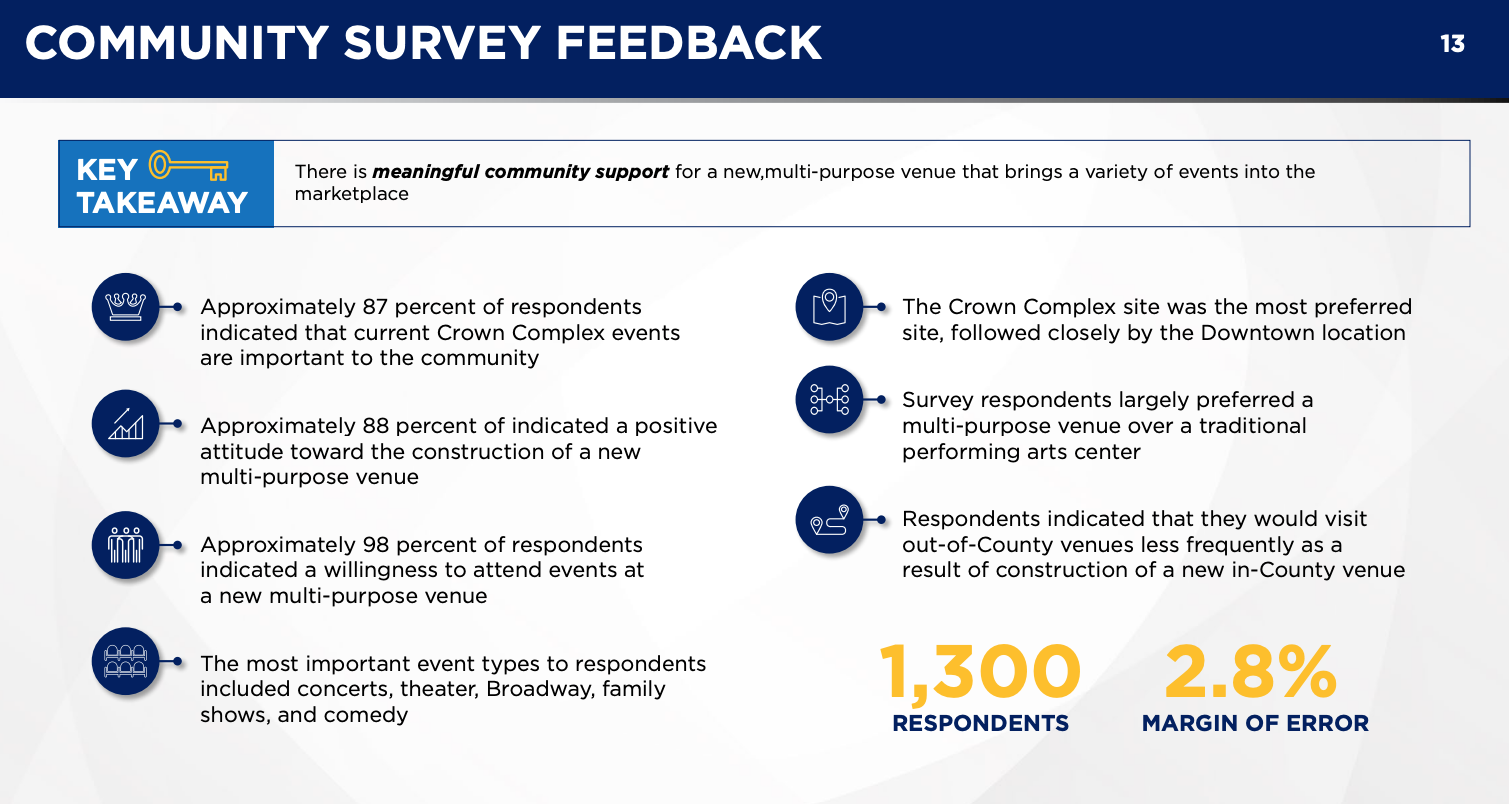
This matters because it means we weren't just ignoring fiscal responsibility—we were potentially ignoring what the community wanted.
The Parking Problem Nobody Solved
The most glaring issue with the downtown Crown project was something you'd think would be basic: where would people park?
The $33 million parking garage was never properly planned (or funded) as part of the original project—it was an add-on that would have increased total costs by 25%. The parking plan was fundamentally flawed including no on-site ADA parking on the selected layout.
Here's what's particularly troubling: we were not shown any current design plans or funding mechanism for the proposed parking deck. Additionally, the new board members were not briefed on a contract with Samet Construction for the parking deck or the over $380K that had been obligated to it by previous board. We were being asked to approve a $178 million project where nearly 20% of the cost was for parking that hadn't even been properly designed yet.
This wasn't just a cost overrun—it was a project that hadn't been properly planned.
A Project with Limited Use
Beyond the cost and design issues, the project only provided an estimated 144 days of projected use—actually fewer usage days than renovating our existing separate facilities due to configuration limitations. We were being asked to spend $178 million on a facility that would sit empty most of the year.
The Financial Risk Nobody Talked About
Perhaps most concerning was the project's complete reliance on Food & Beverage tax revenue—a funding source that the North Carolina General Assembly can eliminate at any time. The funding mechanism relied solely on Food & Beverage tax without exploring other revenue streams like contributions from Oak View Group (the facility operator), facility naming rights, City of Fayetteville participation, or public-private partnerships, placing the entire burden on taxpayers through restricted funds that the General Assembly could eliminate at any time.
This wasn't diversified risk management—this was putting all our eggs in one very vulnerable basket. There is still a legal question about whether the General Fund would have to "backstop" the project and any operational cost of the entire Crown Complex if this funding source disappeared.
Yes, Food & Beverage taxes are restricted funds that can only be used for specific purposes. But they're still taxpayer dollars, and overcommitting these funds to a single project limits our ability to adapt to future opportunities or needs within their restricted purposes. The notion that we should commit the full debt capacity ($185M) of this revenue source in downtown Fayetteville, vs further enhancements to the Crown Complex that could include convention space with an attached hotel, or even recreational facilities, is not a sound financial principle
The Rush to Break Ground
The previous board approved $26 million in spending within two weeks of our taking office, leaving us no opportunity for value engineering, design modifications, or addressing critical structural flaws in the project. We were essentially locked into a flawed design that wasn’t fully vetted, and it was rushed just to have a groundbreaking ceremony.
What We've Already Spent and What Happens Next
$36 million is what has been spent or encumbered. Approximately $14 million has been spent to date (2022-2024), and we are conducting a thorough review to determine exactly what can be recovered from the $22 million in encumbered funds. The good news is that some of these commitments were made for materials and services that can be redirected or cancelled, and we are pursuing every avenue for recovery.
Additionally, the site preparation work already completed won't be wasted—it will become part of any future development at the downtown Fayetteville location, ensuring that the investment serves the community moving forward.
UPDATE OCTOBER 2025
You deserve to know exactly where your money went, so here’s the full accounting now that all obligations have been settled:
Total Spent: $19,598,433
Architect $5,872,563
Construction $5,491,729
Land Acquisition $1,324,081
Owners Agent $889,511
Construction Other $392,258
Engineering Fees $83,786
Surveying $59,096
Contingency Operating $31,505
License & Permits $6,772
Remember, when our board took office, we inherited $36 million in spending that had already been committed. The previous board approved $26 million of that within two weeks of our swearing in, leaving us no opportunity to pump the brakes, pursue value engineering, or address the project’s fundamental flaws. By the time we had the authority to act, contracts were signed and funds were obligated.
Through diligent work by our staff, we recovered approximately $16.4 million. This included cancelling remaining construction obligations, architectural contracts, and professional services before additional work was performed.
Not every dollar spent on this project is lost. Part of responsible stewardship means being honest about what we can salvage.
Nearly $1.9 million of the total investment is tied directly to the Gillespie Street site and work that any future development will inherit:
Land Acquisition $1,324,081
Surveys (boundary, topographical, locational) $59,096
Geotechnical & Engineering (soil assessments, drilling, subsurface utility mapping) $83,786
Utility Relocation (transformer, duct bank, infrastructure) $350,907
Ground Penetrating Radar & Utility Locating $71,581
Total Site-Ready Investment $1,889,453
This isn’t money that disappeared. It is money that prepared a site for development. The soil has been tested. The utilities have been mapped and relocated. The boundaries have been surveyed. Whatever comes next on that downtown lot won’t have to start from scratch.
The remaining $17.9 million represents project-specific costs including architectural designs, construction work, and professional services tied to managing that particular project. Those are true sunk costs we cannot recover.
But here’s the bottom line: any future partner, developer, or county project that uses the Gillespie Street site will benefit from nearly $1.9 million in site preparation already completed. That is the foundation we are building on as we determine the right path forward for the downtown Fayetteville site.
This is the transparency you elected us to provide.
What This Decision Means
Let me be clear about what halting the Crown project does and doesn't mean:
It doesn't mean we've given up on downtown Fayetteville. We remain committed to downtown revitalization, but it has to be done thoughtfully and sustainably.
It doesn't mean we're opposed to entertainment venues. Our community deserves quality cultural and entertainment options, but they need to be financially viable and properly planned.
It does mean we're committed to fiscal responsibility. When a project grows from $80 million to $178 million (or more) with insurmountable flaws, continuing forward would be irresponsible to taxpayers.
It does mean we believe in data-driven decision making. When the community survey shows different preferences than what was being implemented, we need to listen.
Moving Forward Responsibly
The parking lot site will not sit vacant. In the short term, we need to restore adequate parking around our courthouse for employees and visitors. Moving forward, we are committed to determining appropriate future development opportunities that serve the broader community while providing economic benefits to downtown.
This decision doesn't end our commitment to downtown Fayetteville development—it redirects it toward more responsible and sustainable options rather than betting everything on one venue.
Next Steps: Modernizing Our Existing Facilities
Rather than abandoning our commitment to quality entertainment venues, we're taking a more responsible approach. We've directed our county manager to develop a Request for Qualifications framework to modernize the existing Crown Arena and Theater. This RFQ will include a not-to-exceed price as established by the Board of Commissioners, ensuring we maintain fiscal control from the beginning.
We're also coordinating with Oak View Group to ensure continuity of programming in the facilities during renovations. Our community shouldn't have to go without entertainment options while we improve what we already have. This approach allows us to enhance our existing facilities while maintaining the programming and events that our residents and visitors enjoy.
This represents exactly the kind of thoughtful, measured approach that was missing from the downtown project—setting clear financial parameters upfront, working with our existing partners, and ensuring minimal disruption to current services.
It means we can invest in projects that have been thoroughly vetted, properly designed, and enjoy genuine community support based on accurate information rather than manipulated survey data.
Most importantly, it means we can rebuild trust in county government by showing that we'll make hard decisions based on facts, not politics or pressure.
Your Trust Matters
I know this decision disappoints people who were excited about the Crown project. That disappointment is real and valid, and I don't minimize it.
When you elected me to this office, you placed your trust in my judgment to make decisions in the best interest of our entire community, even when those decisions might be unpopular or politically difficult. Throughout my years of service—from Fayetteville City Council to the State Senate and now as County Commissioner—I've tried to honor that trust by following the facts wherever they lead, even when it meant changing course on projects I once supported.
Your trust in county government matters more than any single project or any individual politician's reputation. That trust is built by making responsible decisions with your tax dollars based on data and community input, not on political pressure or predetermined outcomes. It's earned by being willing to admit when something isn't working and having the courage to pivot toward better solutions.
The Crown project, as designed and committed to, would have been a betrayal of that trust. The cost overruns, design flaws, and rushed timeline represented everything that erodes public confidence in government. You didn't elect me to rubber-stamp bad decisions or to avoid difficult choices because they might be unpopular.
We can do better. We must do better. And with your continued engagement and trust, we will do better.
Are you going to use the available redevelopment incentives for the renovation of the Crown Complex? These incentives can likely cut the $100 million renovation budget to a net $50-$60 million renovation.